
New materials for batteries: prices from the manufacturer
2026-10-05
- New battery materials: impact on cost and performance
- Evolution of materials science in lead-acid technologies
- How new materials affect the price from the manufacturer
- Comparative analysis of technologies: Traditional vs New materials
- Application in real industrial conditions
- Technical parameters and product selection
- Quality control and environmental responsibility
- Frequently asked questions (FAQ)
- Recommendations for selection and purchase
New battery materials: impact on cost and performance
In 2026, the energy storage system market will experience structural changes caused by the introduction ofnew materials for batteries. For industrial buyers and engineers, this means not just a change in marketing slogans, but a need to reconsider technical specifications and budgets. The transition from traditional lead-acid solutions to hybrid technologies, the use of carbon additives in negative electrodes and the improvement of AGM separators directly affect the final price of the product and its life cycle.
Understanding how innovations in materials science shape pricing is critical to optimizing project costs in telecommunications, renewable energy and industrial transportation. The price from the manufacturer today depends not only on the weight of the lead, but also on the complexity of the chemical processes that ensure fast charging, resistance to deep discharges and operation in extreme temperature conditions. In this review, we'll look at the technical aspects of new materials, their impact on performance, and the factors that determine the true cost of batteries for businesses.
Evolution of materials science in lead-acid technologies
Traditionally, lead-acid batteries have been considered a mature, low-change technology. However, the appearancenew materials for batteriesallowed to significantly expand their operational boundaries. The key driver of change was the need to increase energy density and charge acceptance speed, which was previously the prerogative of lithium-ion systems, but required significantly greater capital investment.
Carbon additives and graphene
One of the most significant innovations was the introduction of carbon materials (graphite, graphene, carbon nanotubes) into the active mass of the negative electrode. In classic batteries, sulfation of the negative plate is the main cause of failure under cyclic loads. Carbon additives create a conductive three-dimensional network that:
- Reduces internal battery resistance by 15–20%.
- Accelerates the crystallization process of lead sulfate during charging.
- Increases charging efficiency at low temperatures (down to -30°C).
For manufacturers, this means more complex paste formulations and the need for more stringent control of the dispersion of carbon particles. For the consumer - increased battery life in partial charge modes (PSOC), typical for solar power plants and UPS systems.
Advanced lattice alloys
The transition from traditional antimony alloys to calcium-tin alloys with microadditives of silver or aluminum makes it possible to reduce self-discharge and gas evolution. New alloying elements provide better corrosion resistance of the positive electrode grids, which is critical for the longevity of CP Series stationary batteries and CL 2V tubular monoblocks. The use of such alloys requires more precise injection molding, which increases production costs but is offset by reduced maintenance requirements.
New generation separators
Microporous ultrafine glass fiber (AGM) separators with improved pore structure optimize electrolyte retention. New materials provide a more uniform distribution of acid across the height of the plate, preventing electrolyte separation - a common problem in tall stationary batteries. This directly affects voltage stability and prevents premature failure of the cells at the top of the block.
How new materials affect the price from the manufacturer
Request "new materials for batteries prices» often leads to misunderstanding of the cost structure. Innovation does not always mean that the final product will be more expensive in the long term, although the initial capital costs may be higher. The price is formed under the influence of several factors:
- Cost of raw materials:Carbon nanomaterials and special alloying additives are more expensive than standard lead and antimony. However, their content in the battery is small (fractions of a percent), so the price increase due to raw materials is limited.
- Technological process:The introduction of new materials requires modernization of paste mixing lines and quality control. For example, graphene dispersion requires special equipment, which is amortized in the cost of production.
- Economies of scale:With mass adoption of technologies such as lead-carbon (PbC) solutions, production costs are falling. Nanjing Qiantan Energy Storage Technology LLC, having a full production cycle from grid casting to assembly, can optimize these costs by offering competitive prices for OPzV gel batteries and high-temperature batteries.
- Lifetime and TCO:The main savings are in total cost of ownership (TCO). A battery with new materials can cost 10–15% more than an analogue, but last 2–3 times longer in cyclic mode, which reduces the frequency of replacements and logistics costs.
Engineering experience shows that when choosing between a cheap traditional battery and a more expensive version with carbon additives for facilities with unstable energy supplies, the second option pays for itself already in the second year of operation due to the absence of emergency downtime.
Comparative analysis of technologies: Traditional vs New materials
To make an informed decision, it is necessary to compare the characteristics of standard lead-acid batteries and solutions usingnew materials for batteries. Below is a table comparing key parameters for industrial applications.
| Parameter | Traditional lead acid (FLA/AGM) | Lead-carbon / Gel with additives (OPzV/CG) | Lithium-ion (LiFePO4) |
|---|---|---|---|
| Specific energy | 30–40 Wh/kg | 40–50 Wh/kg | 90–120 Wh/kg |
| Cyclic life (80% DOD) | 300–500 cycles | 1200–1500 cycles | 3000–5000 cycles |
| Charge speed | Low (requires long leveling) | High (accepts current up to 0.5C) | Very high (up to 1C and above) |
| Temperature sensitivity | High (loss of capacity in the cold) | Medium (best performance at low T) | High (requires thermal management) |
| Cost of ownership (5 years) | High (frequent replacement) | Medium/Low | Low (with intensive cycling) |
| Security requirements | Low (non-flammable electrolyte) | Low | High (risk of thermal runaway) |
The table shows that batteries using new materials occupy an optimal niche between traditional lead and lithium solutions. They offer significantly better life than standard AGMs while maintaining safety and without the complex management systems (BMS) required for lithium.
Application in real industrial conditions
The introduction of advanced materials is most justified in specific operating conditions where traditional batteries show low efficiency.
Scenario 1: Telecommunications towers in remote regions
Problem:Unstable power supply from diesel generators, frequent interruptions, extreme temperatures (from -40°C to +50°C). Traditional batteries quickly sulfate due to incomplete charge.
Solution:Use of OPzV gel batteries or HFS series lead-carbon batteries from Nanjing Qiantan LLC. Thanks to carbon additives, such batteries effectively receive charge in short pulses from the generator. The improved thermal stability of the separators prevents the electrolyte from drying out in the hot climates of Iran or Pakistan, where the company implements projects.
Result:Increasing the service interval from 1 year to 3–5 years, reducing diesel fuel consumption due to more efficient use of charging windows.
Scenario 2: Electric warehouse vehicles (forklifts)
Problem:The need to work in several shifts, lack of time for a full 8-hour charge. Rapid degradation of EV series traction batteries due to constant partial discharges.
Solution:The use of traction batteries with a modified active mass and reinforced grids. New materials allow charging at any opportunity without memory effect and serious loss of capacity.
Result:Ability to work 24/7 with short breaks to recharge. Reduced equipment downtime. Despite the higher initial price, the total number of batteries replaced over 5 years is halved.
Technical parameters and product selection
When ordering batches of batteries, it is important to pay attention not only to the capacity (Ah), but also to parameters depending on the materials used. Nanjing Qiantan Energy Storage Technology LLC offers a wide range of products, where each type is optimized for its own purposes.
Key series and their features:
- EV Series (Traction):Designed for deep discharges. They use reinforced tubular plates and special separators that are resistant to vibration. Ideal for loaders and harvesting equipment.
- Series OPzV and CG (Gel):Maintenance-free, with immobilized electrolyte. Excellent for solar power stations and UPS. The gel structure prevents acid leakage and ensures operation in any position.
- HFS and CT Series (High Power Front Terminal):Designed for applications with high discharge current (data centers, starter systems). Front terminals simplify installation and reduce connection resistance.
- Series 1S (Automotive):Maintenance-free starter batteries with calcium technology providing high starting current at low temperatures.
- Series CP (Stationary) and CL 2V (Tubular monoblocks):Flagship solutions for long-term reserve power (up to 20 years of design life). Alloys with high corrosion resistance are used.
When creating technical specifications, you should indicate not only the voltage and capacity, but also the expected load profile (direct current, pulsed current, depth of discharge). This will allow the company’s engineers to select the optimal chemical composition and design of the plates.
Quality control and environmental responsibility
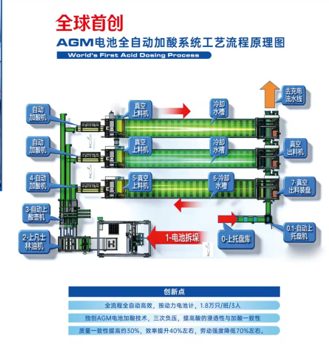
Usagenew materials for batteriesimposes increased requirements for quality control. Any deviation in the proportions of carbon additives or the purity of the lead alloy can lead to rejection of the entire batch. Nanjing Qiantan LLC's production capabilities include automated assembly lines and acid filling systems that minimize human error.
An important aspect is environmental friendliness. The company has a specialized workshop for processing used lead-acid batteries. This ensures a closed production cycle: old lead is cleaned and returned to the production of new grilles, and plastic components are recycled. This approach not only reduces the environmental footprint, but also stabilizes the raw material base, protecting customers from sharp fluctuations in prices for primary lead on world exchanges.
For Russian and international partners, this means a guarantee of product compliance with environmental standards and the availability of a full package of documents for customs clearance and disposal.
Frequently asked questions (FAQ)
Do new materials affect compatibility with older chargers?
In most cases, no. Lead-acid carbon (PbC) batteries and OPzV gel batteries have similar charge voltage profiles to traditional AGM and Flooded batteries. However, to realize the full potential of fast charging performance, it is recommended to use chargers with algorithms that support higher currents initially. Always check the manufacturer's recommendations for absorption voltage and float mode.
Why are the prices of batteries with new materials higher?
The price is determined by the cost of innovative additives (graphene, special polymers) and the more complex technological process of their implementation. However, this difference is offset by an increased service life (2–3 times) and the ability to work in harsh conditions without loss of capacity. When calculating the project budget, it is important to consider the cost of ownership (TCO), not just the purchase price.
Is it possible to mix old and new batteries in one bank?
Strongly not recommended. Batteries with different internal resistances and plate chemistries will charge and discharge unevenly. This will lead to overcharging of some cells and undercharging of others, resulting in rapid failure of the entire circuit. When upgrading a system, the entire battery bank must be replaced at the same time.
What certificates confirm the quality of your products?
The products of Nanjing Qiantan Energy Storage Technologies LLC meet international safety and environmental standards. We provide the necessary certificates for export to Russia, CIS countries, Europe and Asia. The specific list of documents (CE, ISO, test reports) depends on the battery type and delivery region and is available on request.
How do new materials affect battery weight?
The weight remains comparable to traditional lead-acid analogues, since the basis of the mass is lead. However, by increasing the specific energy by improving the efficiency of using the active mass, it is possible to obtain a slightly larger capacity with the same dimensions and weight, or to reduce the dimensions while maintaining the capacity.
Recommendations for selection and purchase
Engineering and procurement teams should consider the following principles when planning battery system procurement in 2026:
- Audit of operating conditions:Determine the actual load profile. If there are frequent deep discharges or operation at low temperatures, traditional batteries will not be cost effective. Choose series with carbon additives or gel technologies.
- Supplier verification:Make sure that the manufacturer has its own full production cycle and quality control laboratory. Having its own processing cycle, like Nanjing Qiantan LLC, is a marker of business sustainability and responsibility.
- Request technical documentation:Request graphs of service life versus depth of discharge (DoD) and temperature for the exact model you choose. Compare this data with current solutions.
- Logistics and service:Consider the geography of supplies. The company implements projects in Russia, Turkey, Iran and other countries, providing engineering support and supply of spare parts. Local support is critical for industrial facilities.
Choosing the right materials is an investment in the reliability of your business. Switching to modern lead-acid technologies with improved characteristics allows you to achieve benefits similar to lithium systems, but with fewer safety risks and clearer disposal economics.
To obtain detailed technical specifications, calculate the cost of a batch for your project or advice on the choice of series (EV, OPzV, HFS, CP), contact our engineers. We are ready to provide samples for testing and develop an individual solution for your needs.
Find out more about ourproducts and technical solutionsfor energy storage systems.