

Key parameters of batteries for energy storage systems: SOC, SOH, DOD, EOL, etc.
2026-09-27
Key parameters of batteries for energy storage systems: SOC, SOH, DOD, EOL, etc.
In-Depth Analysis and Relationships
Prepared and published by Nanjing Qiantan Energy Storage Technology Co., Ltd. | Original material from Energy Dimension
SOC, SOH, DOD and EOL are critical baselines in operating and maintaining energy storage systems, developing BMS (battery management system) strategies, assessing battery life, lifecycle asset management and revenue calculations; BOL, SOE, cycle life and calendar service life act as important additional parameters. Most of the industry's problems—such as misinterpretation of parameters, failures in control strategies, and errors in life estimation—are due to confusion between concepts related to current condition, operating conditions, and life limits.
In this article, all parameters are defined and classified within a single system, while the differences, boundaries and cause-and-effect relationships between them are explained. Instead of separating basic and advanced parameters, an integrated approach is used here, creating a logical system of parameters ready for direct engineering use.
I. Uniform definitions of battery condition and service life parameters
This section combines all basic and derived parameters; their description is based on the logic: “instant state - operating mode - health status/aging - service life boundaries.” All parameters are considered equal, without hierarchical division.
1. SOC (State of Charge)
Definition: The ratio of a battery's current remaining usable capacity to its current actual maximum usable capacity, expressed as a percentage.
Key Feature: Real-time dynamic charge level.
Value range: 0%–100%.
Main properties: Constantly changes, reversible process, does not depend on aging; reflects only the residual charge at a specific point in time.
Engineering significance: Used to control the start and stop of charge/discharge processes, dispatch in the power grid and limit power; serves as a reference point for the daily operation of energy storage systems.
2. DOD (Depth of Discharge - depth of discharge)
Definition: The ratio of the capacity delivered by a battery during one charge-discharge cycle to its current actual maximum usable capacity, expressed as a percentage.
Key characteristic: Indicator of resource consumption during operation (result of a specific action).
Value range: 0%–100%.
Basic properties: Determined by the upper and lower limits of the SOC; …manageable through strategy; is the direct cause of battery aging. Engineering significance: determines the contribution of an individual cycle to the aging process; This is the most important controlled variable affecting the cycling life of the battery.
3. SOH (State of Health)
Definition: the ratio of the current maximum useful capacity of the battery to its nominal factory capacity; the assessment can be supplemented with data on internal resistance and power loss.
Essence: accumulated state of aging (slowly changing, irreversible value).
Main characteristics: monotonic decline; slow, long-term degradation; reflects the physical state of the battery hardware.
Threshold values: 100% corresponds to a new battery; 80% is the critical degradation threshold in the energy storage industry.
Engineering Significance: Used for condition assessment, uniformity screening, residual value estimation and service life prediction.
4. EOL (End of Life)
Definition: The threshold value for making a decision to retire when battery performance no longer meets engineering standards; it is a criterion determined by rules, not a quantity measured in real time.
Essence: criterion for determining the end of service life.
Industry standard: EOL condition is reached when battery capacity drops to 80% of rated capacity (SOH = 80%); for power batteries (power-type), the determination may also take into account internal resistance, temperature rise and disturbances in the uniformity of characteristics.
Engineering value: determines the end of the useful life cycle of the battery; serves as the basis for calculating depreciation, planning replacement and organizing cascade use.
5. BOL (Beginning of Life)
Definition: The initial condition of a new product after factory calibration and before formal commissioning.
Entity: the starting point for the entire life cycle.
Characteristics: SOH = 100%, minimum internal resistance, optimal uniformity of characteristics, no accumulated aging.
Engineering Significance: Serves as the single reference point for all aging calculations, life degradation comparisons, and performance comparisons.
6. SOE (State of Energy)
Definition: The amount of energy available for output (kWh), taking into account voltage, temperature and efficiency. The gist: a real-time status indicator in terms of energy reserves.
Difference from SOC: SOC reflects the “percentage of capacity”, while SOE represents the “actually available energy”, making it more meaningful for power plant financial calculations. Engineering Significance: Used for precise economic load sharing, energy arbitrage metering, and control of long-term energy storage systems.
7. Cyclic resource (Cycle Life)
Definition: the number of complete charge-discharge cycles that a battery can go through during the period from the start of operation (BOL - Beginning of Life) to its end (EOL - End of Life) at a fixed temperature, current (C-rate) and depth of discharge (DOD).
Key characteristic: the limit of resistance to aging under specific operating conditions.
Basic principle: cycle life indicators are meaningless without reference to DOD and temperature.
8. Calendar Life
Definition: The amount of time a battery naturally ages over time, whether it is in use or not.
Key characteristic: the limit of natural aging in the time dimension.
Features: determined by self-degradation of materials, natural growth of the SEI layer (solid electrolyte interface) and aging of the electrolyte; does not depend on the number of cycles.
II. Classification of parameters and main differences
Grouping parameters by physical characteristics allows you to clearly distinguish between concepts that are often confused:
1. Real-time status category (changes at any time, reversible process)
Includes: SOC, SOE.
Characteristics: reflects the current state of the battery; values may increase or decrease (charge or discharge) and do not characterize the health (wear) of the battery.
Analogy: “remaining physical strength” of a person.
2. Category of operating conditions / operating mode (controlled parameter; determines the rate of aging)
Includes: DOD.
Characteristics: the result of the chosen operating strategy; does not reflect the current state, but determines the future rate of degradation of the SOH (State of Health) indicator.
Analogy: “intensity of one workout”; the higher the intensity, the greater the wear. 3. Category “Service life, aging and boundary conditions” (irreversible unidirectional degradation, fixed threshold values)
Includes: BOL (initial state), SOH (state of health), cycle life, calendar life, EOL (end of service life).
Characteristics: Degradation occurs cumulatively over time and during operation; the condition can only worsen (self-healing is not possible), which determines the useful life of the battery.
Understanding at the everyday level: Similar to the “degree of physical aging and maximum life expectancy” of a person. III. Relationship of all parameters
1. Relationship between SOC (state of charge) and DOD (depth of discharge) (strong interdependence of state and operating mode)
– Mathematical connection: Within one full cycle, DOD = 100% – final SOC.
– Logical connection: The operating range of the SOC determines the DOD value.
Example: Operating between 20% and 90% results in an actual maximum DOD of 70%.
– Key difference: SOC reflects the “amount of energy remaining at a given moment,” while DOD characterizes the “intensity of use in a particular case.”
– Engineering Aspect: SOC control strategies are essentially depth of discharge (DOD) aging control strategies.
2. Relationship between DOD and SOH (critical cause-and-effect relationship in the system)
This is the key link of the entire system:
– Higher DOD → greater depth of lithium ion intercalation/deintercalation per cycle, more side reactions and greater thickening of the SEI (solid electrolyte interface) layer → greater loss of SOH per cycle.
– With the same number of cycles: the aging rate at DOD 100% is significantly higher than at DOD 80%, resulting in a reduction in service life of more than 30%.
– Conclusion: The degradation rate of SOH is determined mainly by the average DOD value over a long period.
3. Relationship between SOH and EOL (current process indicator vs. decision threshold)
– SOH is a continuously changing monitored parameter.
– EOL is a fixed threshold that determines when to decommission.
– Life cycle chain: BOL (100%) → continuous discharge cycles (DOD) and aging → gradual reduction of SOH → SOH reaches 80% (EOL condition triggered) → decommissioning. 4. Relationship between SOC/SOE and SOH (total independence; most likely area of misinterpretation)
– The SOC level does not reflect the state of health (SOH) of the battery.
– A worn battery with low SOH may reach 100% SOC (full charge), but its actual usable energy capacity is significantly lower than that of a new battery.
– Functional distinction: SOC determines the operating schedule, and SOH determines the service life of the asset; they do not replace each other.
– SOE value: allows you to take into account the difference in capacity between new and old batteries, providing an estimate of the actual energy available.
5. Double constraints: cycle life, calendar life and EOL (end of service life)
There are two ways for a battery to reach EOL state:
1. End of life due to cyclic aging: Frequent deep charge/discharge cycles exhaust the cyclic life, leading to EOL.
2. End of life due to calendar aging: infrequent use at low intensity leads to the end of its service life, with materials naturally degrading to an EOL state.
The service life of an energy storage system is determined by whichever of the two limitations occurs first.
IV. Generalized engineering conclusions
1. Depth of Discharge (DOD) control is equivalent to lifetime control; The optimal strategy for any energy storage system is to find a balance between revenue generated and degradation caused by depth of discharge (DOD).
2. Use SOC to control energy quantity, SOE to calculate revenue, SOH to evaluate condition, and EOL to make decommissioning decisions.
3. The logical chain of the complete life cycle of an energy storage system battery is as follows: BOL (new battery) is the starting point; DOD is a factor that determines degradation; SOH - result of aging; EOL - end of life cycle.
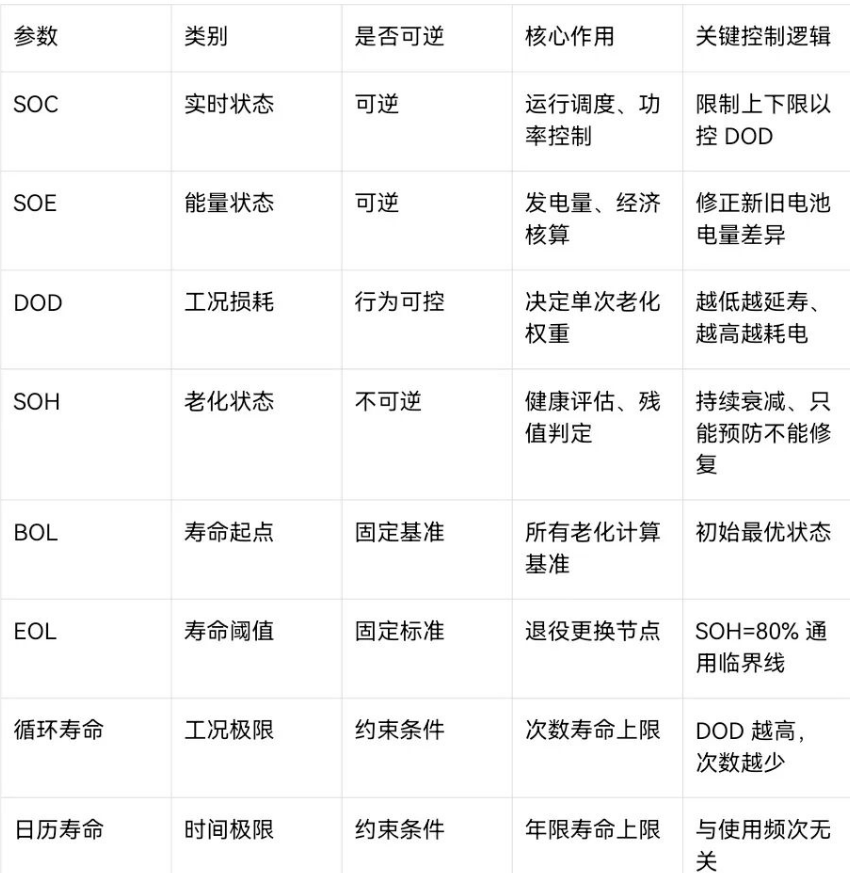
V. Parameter comparison summary table
Prepared and published by Nanjing Qiantan | Saturday, September 26, 2026