

An in-depth analysis of the main effects of virgin lead GB/T 469, recycled lead GB/T 21181 and fire-refined lead on the performance of lead-acid batteries.
2026-11-18
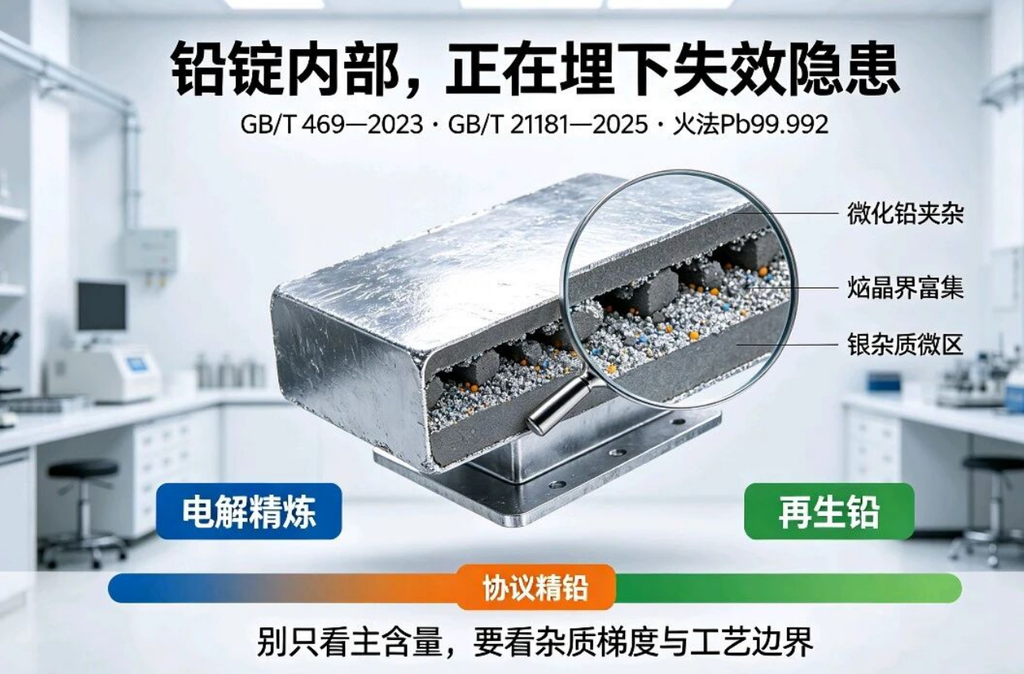
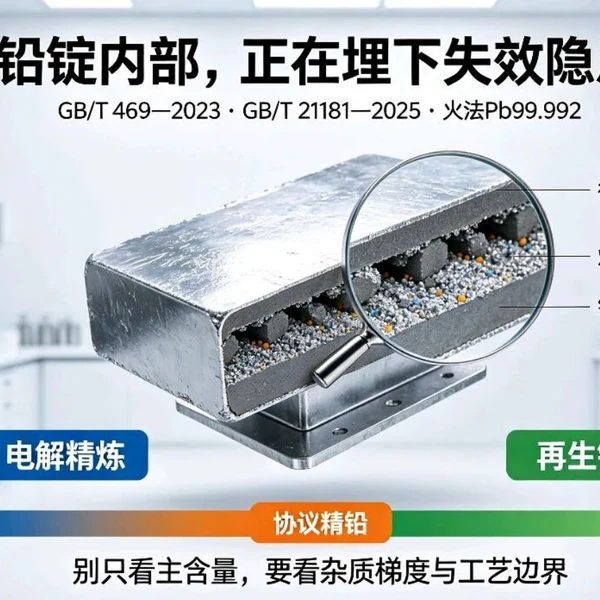
In a lead-acid battery manufacturing system, the purity and impurities of plate alloy substrate components are the main variables that determine the electrochemical stability, service life, self-discharge rate and group stability of the battery. Currently, there are two common and harmful misconceptions regarding raw materials in the domestic lead acid industry. "Lead 99.99% purity" simply separates the grades of raw materials, ignoring the differences between the two grades Pb99.996 and Pb99.994 within GB/T 469-2023, as well as the difference between GB/T. The gradient difference between the three grades ZSPb99.990, ZSPb99.986 and ZSPb99.983 within 21181-2025 confuses the two national standard systems, resulting in raw material inconsistency, process inconsistency and discrete batch production. Second, given the industry's need to reduce costs, many battery companies have phased out expensive electrolytic virgin lead and moved away from conventional recycled lead, instead using large quantities of recycled lead.Fire cleansingRefined lead (non-standard) Pb99.992). This raw material is obtained by melting raw lead + oxidizing and removing impurities. There is no electrolysis process. It does not belong to any national brand. It is an internally controlled lead ingot, agreed upon by both the supply and demand sides. It performs better than conventional recycled lead on paper and has become the primary choice of mid-range battery manufacturers to reduce costs. However, the industry rarely studies the specifics of impurities and metallurgical defects, which are the root causes of many hidden quality incidents. This article is based on GB/T 469-2023 "Lead ingots", GB/T 21181-2025".Recycled Lead Ingots》Two national standards separating the boundaries of each brand, combined with the industry's general fire safety laws. Pb99.992 internal control indicators, from metallurgical mechanism, impurity appearance characteristics, electrochemical destruction path, mesh alloy preparation,lead powderPreparation, positive and negative electrode compatibility, process fault tolerance space and enterprise quality control system systematically analyze the significant differences between the three kinds of lead raw materials and different grades.
Definition of the first and third types of lead raw material systems: removal of national standard grades + Clarification of the Fire Law Agreement
1. GB/T 469-2023 Electrolytically purified lead ingots.
This standard clearly states: Lead ingots suitable for electrolytic refining production are classified into: For the two grades Pb99.996 and Pb99.994, the difference in the limit values of bismuth, silver and total impurities directly determines the upper limit of battery performance. Table 1. Limits of impurity content in the GB/T 469-2023 core (mass fraction, %)
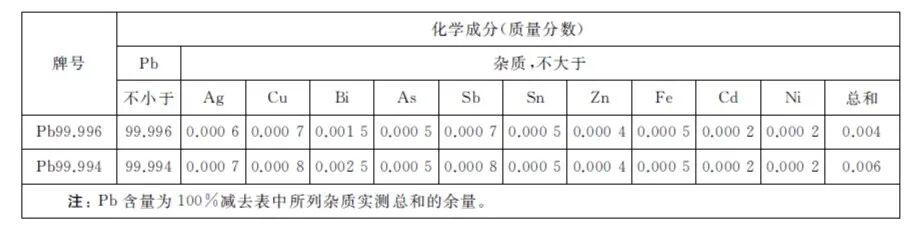
Brand Name Interpretation Pb99.996 (High Quality Electrolytic Lead): Bi≤0.0015%, which is the lowest limit of bismuth in the entire system. It has the best baseline self-discharge and is suitable for demanding negative electrodes, long cycle energy storage devices and communications applications.floating chargeBattery.Pb99.994 (regular electrolytic lead): Bi content is reduced to 0.0025%, the overall upper limit of impurities is higher, and the cost is lower. Suitable for general industrial batteries, power battery positive electrodes and lattice alloys; When using a negative electrode, the charge retention at high temperatures is weaker than Pb99.996, and it cannot directly replace Pb99.996 for floating negative electrodes with a long warranty. General features: the standard does not establish the assessment of trace elements such as sulfur (S), calcium, aluminum, selenium, tellurium, manganese; Thanks to the sorting and purification of the electrolytic potential, harmful impurities are distributed evenly, and the volatility of the batch is low. Industry pitfalls: Many people consider Pb99.994 a defective product. In fact, this is a reasonable gradient step within the national standard, but there are clear performance limits and it cannot be replaced in different scenarios.
2. GB/T 21181-2025 Recycled lead ingots (regeneration of used lead-acid batteries, officially implemented from March 1, 2026)
This standard consists of There are three grades: ZSPb99.990, ZSPb99.986 and ZSPb99.983. The lower the lead content of a given grade, the less stringent the restrictions on bismuth and impurities, and the risk of self-discharge gradually increases. At this stage, there is currently stock of the old version GB/T 21181-2007 in the market and the standard version needs to be confirmed at the time of procurement and acceptance. Table 2. Limits of impurity content in the GB/T 21181-2025 core (mass fractionnumber,%)
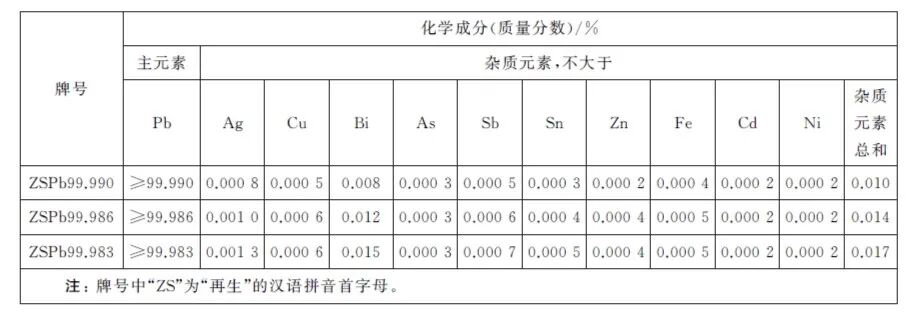
Interpretation of brand names
ZSPb99.990 (High Quality Recycled Lead): Best level of control of impurities in recycled lead. It can be used for low-frequency power and civil batteries, as well as positive lead powders; It is not recommended to use only the negative electrode as the base material.
ZSPb99.986 (medium grade recycled lead): The upper limit of Bi is 0.012%, and the risk of self-discharge increases significantly. It is only suitable for short circulation battery cathodes.
ZSPb99.983 (regular recycled lead): Highest concentration of impurities. It is only suitable for low-cost circulating batteries and is not suitable for products with a long warranty.
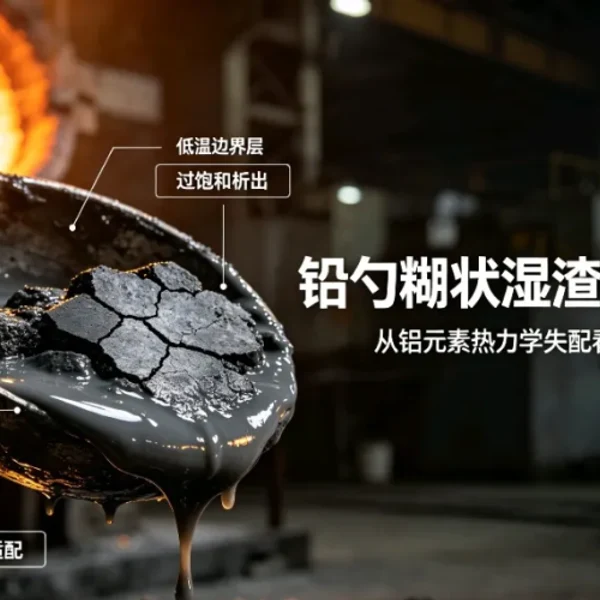
General Features: Raw materials are obtained as a result of fire regeneration of used lead-acid batteries. Bi and Ag are circulating enriched impurities that are difficult to remove to depth; There are also no mandatory sulfur levels in the national standard, and they also exist in the secondary lead system.Sulfide inclusions, the sulfur content fluctuates greatly.
3. Fire refining Pb99,992 (major cost reduction in the industry, fulfilling non-standard agreement)
Metallurgical process: raw lead remelting + Oxidative slagging and impurity removal, no electrolysis process in the whole process. Standard attributes: It is not within the scope of GB/T 469-2023, GB/T 21181-2025 and belongs to the internal control agreement agreed between the supply and demand sides. General indicators of internal control in the materials industry (quality indicator, %)
Pb≥99.992, total impurities≤0.008
Ag<0.0008, Cu<0.0006, Bi<0.0060
Ac<0.0003, Sat<0.0005,Sn≤0.0002
Zn/Fe/Ni/Cd/Ca/Al/Se/Te/Mn ≤0.0002
S≤0.001 (both parties agree on the internal control threshold and the national standard will not be assessed)
Description of location: The indicator is located between Between Pb99.994 and ZSPb99.990; however, there is an inherent disadvantage that lead sulfide inclusions remain within the matrix and the risk of impurity segregation is higher than with electrolytic lead.
2. Horizontal comparison of the main impurities of each brand: Bi, Ag, S, sum of impurities
1. Bismuth Bi (core affecting self-discharge, negative electrode is the most sensitive)
Pb99.996: ≤0.0015% (optimal)
Pb99.994: ≤0.0025%,
fire method Pb99.992: ≤0.0060%
ZSPb99.990:≤0.0080%
ZSPb99.986:≤0.0120%
ZSPb99.983:≤0.0150%
in conclusion: Bismuth reduces the hydrogen evolution overvoltage at the negative electrode and causes self-discharge; The bismuth tolerance of the negative electrode is much lower than that of the positive electrode, and the bismuth limit for a given brand directly determines the battery's ability to hold a charge.
2. Silver Ag (danger of long-term micro-short circuit)
Pb99.996: ≤0.0006%
Pb99.994: ≤0.0007%
fire method Pb99.992: ≤0.0008%
ZSPb99.990:≤0.0008%
ZSPb99.986:≤0.0010%
ZSPb99.983:≤0.0012%
Conclusion: Silver easily forms conductive dendrites under long-term floating charge and high temperature conditions, creating the risk of micro-shorts in the future. Batteries with a long warranty require strict control of the silver content.
3. Sulfur S (general disadvantage of the fire process)
Two national standards GB/T 469-2023 and GB/T 21181-2025 do not establish mandatory sulfur assessment indicators; both recycled lead and fire-refined lead may contain sulfide inclusions. The difference between the two is that the contract material is fire-refined Pb99.992, and supply and demand often agree on S≤0.001% as an internal control threshold, while contracts for processed lead grades generally do not record sulfur values, and the range of sulfur content fluctuations is greater. The electrolytic refining process can significantly reduce the risk of sulfide inclusions.
Electrochemical hazard of sulfur: Sulfides mix inside the plate, forming high resistance areas that cause localized overheating during charging, causing the active material to flake and fall off. After prolonged operation, the group pressure difference increases and productivity decreases.
4. Sum of impurities (general stability scale)
Pb99.996 (0.004) < Pb99.994 (0.006) < Fire method Pb99.992 (0.008) < ZSPb99.990 (0.010) < ZSPb99.986 (0.014) < ZSPb99.983 (0.017)
3. Basic logic of metallurgy: why there is a significant difference in performance between grades of the same purity
1.GB/T 469—2023 Electrolytic lead: Relying on electrolysis potential difference to selectively separate impurities, impurities are evenly distributed in the lead matrix with easy segregation; Bi and Ag can be stably removed to very low levels, and they are the main raw materials for high-performance batteries. It should be noted that this standard applies only to electrolytically purified lead. Even if the composition of pyrometallurgical lead complies with the standards, it is not covered by this standard.
2.GB/T 21181-2025 Recycled lead: From fire smelting of spent lead-acid batteries, Bi and Ag are cyclically enriched impurities, which are thermodynamically difficult to remove to depth; The class classification is essentially a classification of the cost of removing impurities in smelting, and the dispersion of impurities is naturally higher than that of electrolytic lead.
3.fire methodPb99.992: There is a physical upper limit to oxidative slagging and impurity removal. Bismuth and silver cannot be reduced to the level of electrolytic lead; sulfide inclusions cannot be completely removed, and fluctuations in raw material batches are greatly influenced by the source of raw lead raw materials. This "Stable crude lead after optimized performance" is not equivalent to electrolytic lead.
4. Main application areas: the adaptation limits of each grade in the preparation of lattice alloy and the preparation of lead powder.
The most common misunderstanding in the industry: raw material brands do not differentiate between positive and negative poles, and one set of raw materials covers all plates. In fact, the positive electrode and the negative electrode have completely different tolerance thresholds for impurities. The positive electrode has a higher resistance to impurities, while the negative electrode is very sensitive to impurities such as bismuth and sulfur.
4.1. Preparation of alloy mesh
①Pb99.996
Metallographic characteristics: extremely low impurity level, uniform grain, Ca, Sn, Sb and other alloying elements are uniformly dissolved in the solid state without obvious separation. Positive mesh: high resistance to intergranular corrosion, low risk of creep and float growth, suitable for long-life energy storage devices. Negative electrode grid: The bismuth baseline is the lowest, and the hydrogen evolution inhibition effect is the best. It is the preferred negative electrode material for float charge batteries with a long warranty. Suitable alloys: high quality lead-calcium-tin alloy, special alloy for float charging communication.
②Pb99.994
Metallographic characteristics: controlled level of impurities and stable consistency. Positive electrode mesh: The main material for the positive electrode of most industrial batteries and two-wheel batteries with the best economic performance. Negative mesh: can be used for products with short to medium warranty periods; The self-discharge of the high-temperature shelf is higher than Pb99.996, not suitable for the negative electrode to store floating charge energy for more than 3 years. Suitable alloys: common industrial lead-calcium-tin alloys, low antimony alloys.
③ Fire extinguishing method Pb99.992
Metallographic characteristics: Bismuth is easily enriched along grain boundaries, and sulfide inclusions are dispersed in the matrix in the form of small particles. Positive Electrode Grid: Suitable for starting two-wheelers and the positive electrode of mid-range normal power batteries. The sulfur content must be controlled. Negative electrode grid: not recommended for use alone; if it is to be used, it must be mixed with high levels of electrolytic lead and self-discharge suppressing additives. It is strictly forbidden to use it directly as a negative electrode for floating charge batteries.
④ZSPb99.990
Metallographic characteristics: obvious enrichment with impurities, above the upper limit.
Positive electrode grid: positive electrodes of low-frequency power and civil batteries, the corrosion of alloys becomes more discrete, and the design needs to reserve excess corrosion. Negative electrode mesh: It is not recommended to prepare the negative electrode mesh and negative electrode lead powder only as the main materials of the negative electrode; When mixing in small quantities, it is necessary to carry out a special check of the charge content.
⑤ ZSPb99.986 / ZSPb99.983
Metallographic characteristics: severe release of impurities and large batch variations.
Positive Grid: Only used for low-cost short cycle batteries, not suitable for certain brands of products.
Negative Electrode Grid: It is strictly forbidden to use base material to make the negative electrode.
Network reliability rating:Pb99.996 >Pb99.994 >Fire Pb99.992 >ZSPb99.990 >ZSPb99.986 >ZSPb99.983
4.2 Preparation of ball mill lead powder
The degree of oxidation, apparent density and uniformity of the lead powder particles directly determine the reversibility of the reaction with the paste, solidification, formation and plate. Impurities will change the rules of nucleation and growth during lead oxidation.
1.Pb99.996 milling: The matrix is clean, the oxidation rate is stable, the particle size distribution of lead powder is narrow, the dispersion is low; After formation, the structure of lead dioxide is dense, less active material falls off, and the cycle decays slowly. Negative lead paste has less tendency to sulfate and excellent charge retention, making it the best choice for high quality negative electrode lead powder for energy storage.
2.Pb99.994 milling: The oxidation behavior is stable, and it is the main raw material for lead cathode powder in industry; When using a negative electrode, the self-discharge during high temperature storage is higher than Pb99.996, the formula needs to be checked.
3.fire method Pb99.992 milling: Bismuth is preferentially oxidized, and the degree of local oxidation is relatively high; the sulphide particles become stress concentration points and the plate is prone to peeling after solidification and formation. Negative lead powder is not recommended for use alone. It is preferable to mix electrolytic lead.+ Self-discharge inhibitor.
4.ZSPb99.990 milling: Catalytic oxidation of impurities, the oxidation rate fluctuates greatly, and the proportion of fine powder is relatively high; It is only suitable for lead powder of the positive electrode, and the negative electrode cannot be the main material.
5.ZSPb99.986/ZSPb99.983 milling: Poor oxidation control, large variations in apparent density, only used for low quality positive electrodes.
Lead powder consistency rating: Pb99.996 > Pb99.994 > Fire Pb99.992 > ZSPb99.990 > ZSPb99.986 > ZSPb99.983
4.3 Rules for choosing and implementing a brand
1. For high quality energy storage/communication UPS, photovoltaic floating chargers and industrial batteries with ≥3 years warranty, Pb99.996 is preferred for positive and negative electrodes; under budgetary constraints, the positive electrode can be reduced to Pb99.994 and the negative electrode should remain Pb99.996.
2. For starting a medium-range vehicle, two-wheel battery positive mesh and positive lead powder: Pb99.994 or fire method Pb99.992; negative electrode mesh and negative lead powder: Pb99.994 is preferred; When using the Rb99.992 fire extinguishing method, it must be mixed with electrolytic lead, equipped with a self-discharge suppression circuit, and floating charging scenarios are prohibited.
3. Low-quality civilian battery with short circulation, positive grid, positive lead powder: ZSPb99.990, budget squeeze can choose ZSPb99.986; For all grades of secondary lead, it is not recommended to use them as a base material separately for negative electrodes.
4. Hard red line: ZSPb series recycled lead is not recommended to be used alone as the main material of the negative electrode; for small volumes of blending, a special check of the charge content is necessary; fire method Pb99.992 must not be used separately for the positive and negative electrodes of floating charge batteries; Pb99.994 cannot directly replace Pb99.996 for floating negative electrodes with long warranty; Lead ingots of different grades are strictly prohibited from being randomly mixed or mixed with lead powder without a plan or inspection.
5. Typical failure modes corresponding to impurities
1. Pb99.996: Baseline impurity level is extremely low. Most battery failures are due to defects in process control (curing, forming, assembly), and the proportion of failures due to self-discharge and corrosion caused by raw materials is very low.
2. Pb99.994: We control the risk of raw materials. The malfunction is mainly manifested by the weakening of the charge after a long stay at high temperature, and the pressure drop increases slowly under floating charge conditions.
3. Fire method Pb99.992: Typical faults: batch charging remains unstable, voltage variation of batteries in one group, peeling of the active material in the middle and late stages of the cycle, drop in capacity. The main reason is the enrichment of grain boundaries with Bi + sulfide inclusions.
4. ZSPb99.990: The corrosion rate of the positive electrode is discrete, and some batteries lag behind in advance; if the negative electrode is incorrectly used as the base material, self-discharge will exceed the standard and complaints of static power loss will be common. 5. ZSPb99.986, ZSPb99.983: self-discharge batch size exceeds standard, serious float water loss, premature performance loss and high risk of after-sales complaints.
6. List of matching engineering scenes
✅GB/T 469—2023 Pb99.996 Communication base station batteries, UPS, photovoltaic energy storage, long-life industrial series batteries, products with a warranty of ≥3 years and all anode systems in high demand are raw materials that cannot be replaced at will.
✅GB/T 469—2023 Pb99.994 Conventional industrial batteries, batteries for two-wheel engines, positive electrodes of automobile starting batteries, conventional grids of lead-calcium alloy; negative electrodes are limited to non-floating products with a short to medium term warranty.
✅fire method Pb99.992 (material controlled under contract), starter for two-wheelers, general purpose medium power battery; strict restrictions: the contract blocks Bi and S, incoming materials must be tested for Bi and S, a separate production line is dedicated, the negative electrode formula adds self-discharge suppression compensation, and float charge energy storage scenarios are strictly prohibited.
✅ZSPb99.990 (GB/T 21181-2025) low-grade two-wheel motor, civil battery positive grid, positive lead powder; It is prohibited to use it only as the base material for the negative electrode.
✅ZSPb99.986 / ZSPb99.983 (GB/T 21181-2025) is only used for the positive electrode of inexpensive short cycle batteries and is not recommended for certain brands of products.
7. Factory quality control modernization plan: improved control by brand
1. Standardize procurement contracts and eliminate vague language.
High-quality orders: clearGB/T 469—2023 Pb99,996;
Normal power order: clearGB/T 469—2023 Pb99.994;
Orders to reduce the cost of medium range: indicate the firing method Pb99.992, which indicates: it does not belong to the national standard brand GB/T469 and GB/T21181, and the internal control limits of Bi and S are consistent;
Re-orders for leads: ClearGB/T 21181-2025 and the corresponding class ZSPbxxx also indicate the standard version to distinguish between old and new standards.
It is prohibited to write only Vague descriptions such as "high purity lead, 99.99 lead" prevent suppliers from substituting lower grades for higher grades.
2. Differentiated plan for incoming inspection of materials.
Pb99.996, Pb99.994: Focus on Bi and Ag testing and check with national standard limits;
fire method Pb99.992: Mandatory testing of Bi and S indicators (sulfur is usually absent in industry);
ZSPb secondary lead of the third grade: focus on inspection Bi; the lower the brand name, the higher the frequency of spot checks.
3. Insulation of warehouse and smelting partitions.
Ledger independentPb99.996, Pb99.994, fire method Pb99.992, ZSPb99.990, ZSPb99.986, ZSPb99.983 are stored in separate areas, lifted separately, melted separately, a brand traceability book is maintained. Even if they are both electrolytic lead, Pb99.996 and Pb99.994 cannot be mixed and melted at will.
4. Create an independent library of processes for different brands.
Pb99.996: Standard process window, large fault tolerance space, forming and curing parameters are realized in accordance with the high-performance system;
Pb99.994: The positive electrode follows the normal parameters, and the negative electrode adds a high temperature charge maintenance check;
fire method Pb99.992: Reduce the peak charging current, increase the downtime, and the lead paste formula is equipped with additives to suppress self-discharge;
ZSPb Series: Adopts conservative technology, shortens cycle time, strictly controls humidity and curing temperature, and is only used in cathode production lines.
8. Industry Cognitive Core: Just Look 99.99% purity is the biggest misunderstanding.
Many buyers and craftsmen look only at the base lead content and cannot tell the difference. The significant difference between Pb99.996, Pb99.994 and ZSPb99.990 is that "99.99%" is simply considered the same level. What truly determines the self-discharge, corrosion resistance and stability of a battery is not the underlying lead content, but the limits, storage forms and metallurgical pathways of impurities such as Bi, Ag and S behind the brand. Reliability gradient: Pb99.996 > Pb99.994 > Fire safety method Pb99.992 > ZSPb99.990 > ZSPb99.986 > ZSPb99.983.
Fire-refined lead is a compromise on cost. There is a huge gap between the three grades of recycled lead; Even if they belong to the same category, Electrolytic lead GB/T 469-2023, Pb99.996 and Pb99.994 also have clear boundaries of application and cannot be unconditionally interchangeable. Blind cost cutting and brand mixing will save raw material costs in the short term, but will result in batch dispersion, after-sales compensation and brand loss in the later period.
9. Write at the end
The lead-acid battery industry has long said goodbye. The barbaric growth stage of "expensive production facilities and cheap raw materials" has officially entered the era of high-quality competition of standardization, improvement, branding and mechanization.
The outside world appears to have similar values. High purity 99.99% lead ingots actually hide significant differences in metallurgical processes, grade differences between national standards, and performance barriers caused by the microscopic presence of impurities. Electrolytically refined lead, flame refining lead and recycled lead are not simply characterized by high or low content, but have a hierarchical structure in terms of process route, impurity structure, electrochemical stability and product adaptation scenarios. Special attention must be paid: GB/T 21181-2025 has been in force since March 2026. New and old versions of recycled lead are circulating on the market simultaneously. The standard version must be indicated upon acceptance of the purchase.
Raw materials are the first gene and the last indicator of battery quality. The corrosive life of the mesh, the reversibility of the lead powder reaction, the stable power of the positive and negative electrodes, the stability and reduction in the life of the entire battery pack can all be attributed to the precise selection of lead ingot grades. The national standard itself only limits the composition performance and is not equivalent to the naturally adapted battery scenario; Even at the same level of purity, differences in the types and forms of impurities will result in completely different electrochemical performance.
The so-called battery quality gap is not a small difference in equipment and formula, but a gap in raw material knowledge, gaps in standards implementation, and gaps in improved management and control.
At a time when industry involution is intensifying, costs are transparent, after-sales service is strict, and quality guarantees are stretched, the era of blind substitution with low prices is over. Exact fit, material sorting and manufacturing to standards are major barriers to long-term sustainable profitability for businesses. Only by understanding the core logic of lead ingot brands, respecting the technical red lines of access to raw materials and conducting testing within the permitted mixing boundaries, can we achieve controlled quality, controlled costs, controlled reputation and controlled long-term development in a peer-to-peer competition on the Red Sea.
Disclaimer: This articleBy referring to publicly available information on the Internet,It is used only for industrial technical exchange, process research and quality optimization reference information.