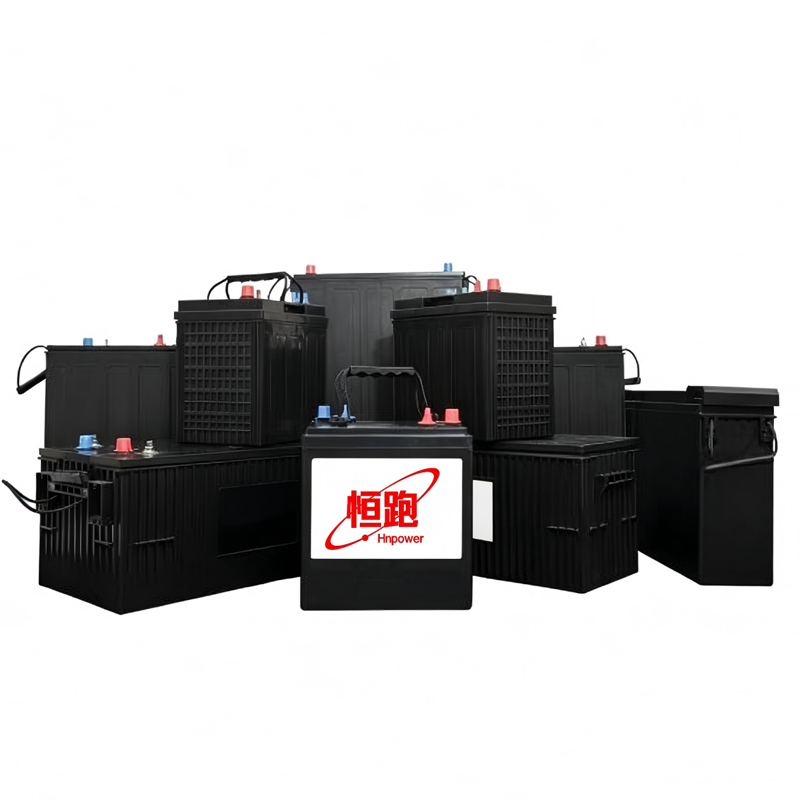


Which parts of the UPS battery are most likely to leak electrolyte?
2026-10-26
What should you do if there is a crack in the housing that causes a small leak but cannot be detected with the naked eye?

During one of the walk-throughs, a small area of white crystalline rust was discovered on the bottom cross member of the battery rack. The battery case looked clean, but as I probed the crossbar segment by segment, I eventually discovered a thin, fingernail-length crack on the bottom corner of one of the segments, where electrolyte had leaked out drop by drop. This element's voltage and internal resistance are usually normal; If it weren’t for that white rust on the rack that “gave out” the problem, we would have had to wait a very long time until it showed up on its own.
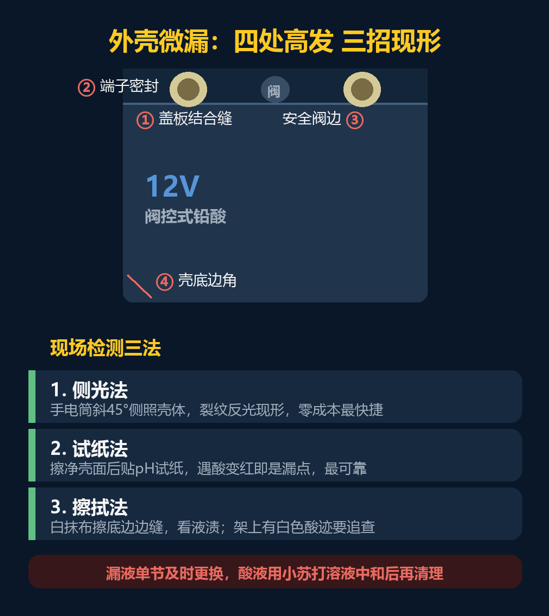
First, you need to find out where micro-leaks most often occur: the four most vulnerable spots
Valve lead-acid batteries are not a solid plastic block; their body consists of a body and a cover connected by heat welding or gluing. It is the places of these connections and holes that are the most vulnerable points for micro-leaks:
1. Cover joint seam. In places where heat sealing or bonding occurs, the sealing material ages and cracks under the influence of long charge-discharge cycles, thermal expansion and contraction, and internal pressure during recharging - this is the most common source of leaks.
2. Terminal sealing. Where the positive and negative poles pass through the cover, leakage is prevented by the sealing structure. After the seal ages, the electrolyte rises up the poles - in professional jargon this is called “acid rise”; the appearance of a white crystalline coating around the base of the poles is basically this phenomenon.
3. Area around the safety valve. If there is a poor seal at the junction of the valve body and the cap, the acid mist released as a result of gas formation in the accumulator condenses around the valve, forming acid spots; although this is not noticeable, it is also a leak.
4. Corners of the bottom of the case. Shocks during transportation and loads during installation are concentrated in the corners; This is where small cracks are often hidden, which under normal conditions are carefully covered by the crossbar of the battery rack, so they are very easy to miss during a visual inspection - this is exactly the situation observed with the battery mentioned at the beginning.
Second, leaks invisible to the naked eye: three ways to detect them
1. Side lighting method: one flashlight is enough
Turn off the overhead light, press the flashlight to the surface of the battery case at a 45-degree angle and move it slowly. The smooth surface of the case looks uniform when illuminated from the side, but if there are small cracks or irregularities in the joints, a boundary between the light and dark zones will be drawn under the side light, and the reflection from the crack can be seen at first glance. This method is cost-free and suitable for every routine inspection.
2. Test paper method: the most reliable evidence
In areas where a leak is suspected, first wipe the surface of the case dry with a clean cloth, then cut a strip of broad spectrum test paper and tape it to the suspect area. Wait a little and see if the color changes. The battery electrolyte is sulfuric acid; When it comes into contact with acid, the indicator paper turns red - red means leakage, damn it. This method is suitable for confirming suspicions revealed by side lighting, and also serves as the basis for recording evidence.

3. Rubbing method: follow the path of the acid upward
Wipe the bottom edge of the battery and the seams at the corners with a white rag to check for wet marks and acid stains; At the same time, inspect the crossbars and shelves of the battery rack - the acid flows down the leak site, and the white crystals on the rack serve as “indicators”; follow them up to find the battery that is leaking. If possible, keep a record of the weight of each battery: with a minor leak, the weight of the battery will quietly decrease over time due to loss of electrolyte.

Third, ignoring small leaks will lead to three consequences, each more serious than the previous one.
1. This battery first becomes a "lagging" cell.
The electrolyte gradually flows out, the liquid level decreases, the effective area of participation of the electrodes in the reaction decreases, and the capacity of this battery imperceptibly decreases. In recharging mode this is not noticeable, but when discharging it is the first to discharge to zero, which leads to a drop in the voltage of the entire battery - many "slow capacity decline" problems originate in one micro-leaking battery.
2. Sulfuric acid corrodes the battery frame and connecting strips.
There is no need to talk about the corrosive activity of sulfuric acid in relation to metals: after corrosion of the crossbars and crossbars of the battery frame, their strength decreases, and corrosion of the connecting strips leads to an increase in contact resistance, which causes heating during discharge and creates another source of overheating.
3. Reduced insulation to ground and alarm of DC system
Leaking conductive electrolyte causes it to accumulate at the bottom of the battery, causing the battery's insulation resistance to ground to decrease and triggering a DC system alarm. In severe cases, this can result in a DC ground fault that requires significant effort to clear.
The white crystals on the battery stand are “signposts”, following which you can trace the source of the problem to a specific battery.

Fourth, if an omission is discovered, act in accordance with this table
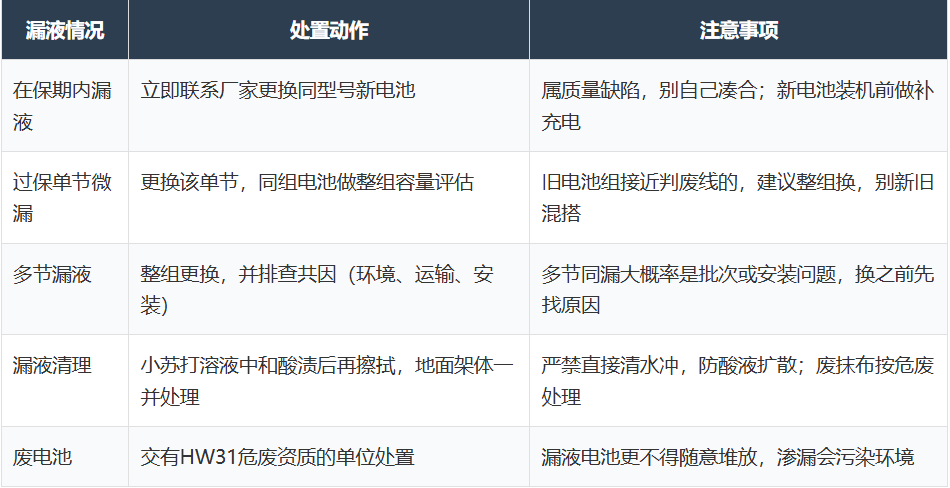
Safety Warning: Wear acid-resistant rubber gloves and safety glasses when handling leaking batteries; If acid gets on your skin, immediately rinse it with plenty of clean water; When replacing batteries, wear insulated gloves and use insulated tools; Contact of metal tools with positive and negative poles is strictly prohibited; rags and materials contaminated with acid should not be randomly discarded and must be disposed of in accordance with hazardous waste regulations.
Fifth, incorporating leak testing into your walk-through schedule is much more cost-effective than cleaning up after the fact.
The greatest danger of small leaks is that they are “discovered too late.” Turn their identification from a random event into a systematic procedure: add the item “Inspecting the exterior of the case + checking the battery racks” to the quarterly walk-through schedule, shine a side light on them and inspect the racks - it only takes ten minutes; Every year, as part of the control discharge, check suspicious elements using indicator paper, update weight data and maintain documentation. In accordance with the operation and maintenance requirements set out in the standards GB 26860-2011 and GB/T 7260.3-2024, visual inspection of batteries is already a routine activity; Taking a little time will ensure the safety of the entire battery.
Remember one thing: the fact that micro-leaks are not visible to the naked eye does not mean that they do not exist - light the battery from the side, apply a test strip, wipe with a white cloth, check for rust on the holder: with such an integrated approach, leaks will not go unnoticed.
Nanjing Qiantan Energy Storage Technology Co., Ltd. with reference to batteries for uninterruptible power supplies (UPS)