

Which parts of UPS batteries are most susceptible to leakage? What to do if a small crack appears on the shell, invisible to the naked eye?
2026-10-28

Upon inspection, a small piece of white crystalline rust was found on the lower beam of the battery rack. The battery housing looked clean, so it could be touched piece by piece along the beam. Finally, you discovered a fingernail-length crack in the bottom corner of the battery, from which electrolyte was leaking drop by drop. The voltage and internal resistance of this battery are normal during normal times. If it weren’t for the white rust on the shelf that “dissuaded” it, I would have had to wait a long time for it to show itself.
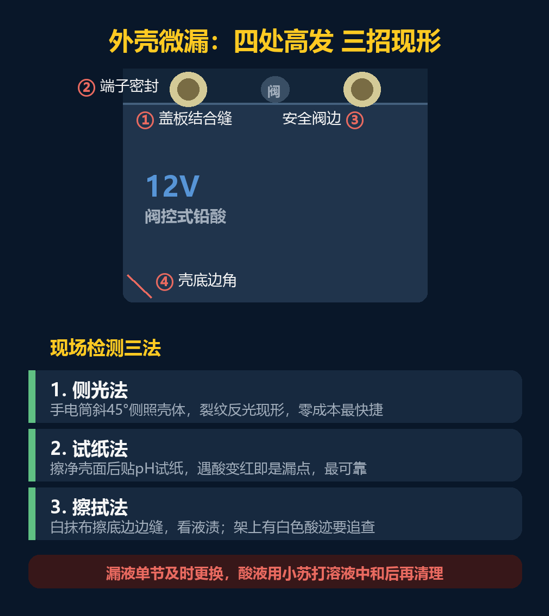
First, let's find out where micro-leaks are hidden: four places with a high incidence rate
Valve-regulated lead-acid batteries are not a solid piece of plastic. The shell is heat sealed or glued together by the shell and the lid. These junctions and openings are the areas most susceptible to micro-leakage:
1. Close the connection.Heat sealed or adhesive joints are affected by long-term thermal expansion and contraction due to prolonged charging and discharging and floating internal pressure. The sealing adhesive ages and cracks, which is the most common seam.
2. Terminal seal.The position where the positive and negative poles pass through the cover is protected from leakage due to the sealing structure. After the seals age, the electrolyte slides up the poles, which is calledRise up sour,At the base of the pole is a circle of white crystals, which is essentially what it is.
3. Around the safety valve.The seal between the valve body and cover is poor, and acid mist carried by battery gases condenses into acid spots around the valve. Although it's not obvious, it's still a leak.
4. Bottom corner of the body.Shocks during transportation and installation loads are concentrated in the corners; small cracks are often hidden here. Usually they are tightly covered with the beams of the battery rack, and they are easiest to miss with the naked eye - the battery is like that at the beginning.
Second, leaks invisible to the naked eye: three tricks to make them visible
1. Side Lighting Method: You can do this with a flashlight.
Turn off the ceiling light, point the flashlight to the side at a 45-degree angle to the battery housing and move slowly. The straight surface of the shell appears uniform under side light, but if there are small cracks or uneven seams, under side light a dividing line will be drawn between light and dark, and the reflection of the cracks can be recorded at a glance. This method is cost-free and suitable for routine inspections.
2. Test paper method: the most reliable and indisputable evidence
If you suspect a leak has occurred, first dry the surface of the shell with a clean cloth, cut a strip of Broad Spectrum pH Test Paper and stick it on the suspect area, wait a moment and observe the color change. The battery electrolyte is sulfuric acid. The test paper turns red when exposed to acid. Red indicates leakage and the writing on white paper is black. This method is suitable for confirming doubts detected by sidelights and is also the basis for maintaining evidence and records.

3. Rub Method: Follow the acid trail upward.
Wipe the bottom edge of the battery and the seams at the four corners with a white rag to check for moisture or acid stains; also check the beams and laminates of the battery rack - acid will flow into the leak area, and white crystals on the rack are “road signs”. Follow the position up to chase the source battery. If possible, create a section-by-section weighing reconstruction file. A battery with a slight leak will lose fluid for a long time and the weight will drop unnoticed.

Third, if minor leaks are ignored, the three types of consequences will be more unpleasant than the previous one.
1. This battery first becomes a reverse cell.
The electrolyte slowly drains, the liquid level drops, the effective area of the plate involved in the reaction shrinks, and the battery capacity imperceptibly decreases. It is usually not visible during floating charging. After discharging, it first drops down and the entire battery voltage decreases. The root cause of many "shrink lag" problems is a battery with a slight leak.
2. Acid corrodes the battery case and connecting strips.
Needless to say, sulfuric acid is corrosive to metals. Battery frame beams and laminates corrode and their strength decreases. Corrosion of the bond strips increases contact resistance and generates heat during discharge, which poses another risk of overheating.
3. The insulation to ground decreases and the DC system generates an alarm.
The leaked electrolyte is conductive, and when it accumulates at the bottom of the battery, it causes the battery's insulation resistance to ground to drop, triggering an insulation fault alarm on the DC system. In severe cases, it will also result in a DC ground fault, which is very time consuming to resolve.
The white crystals on the battery stand are “road signs.” Follow them to the battery source.
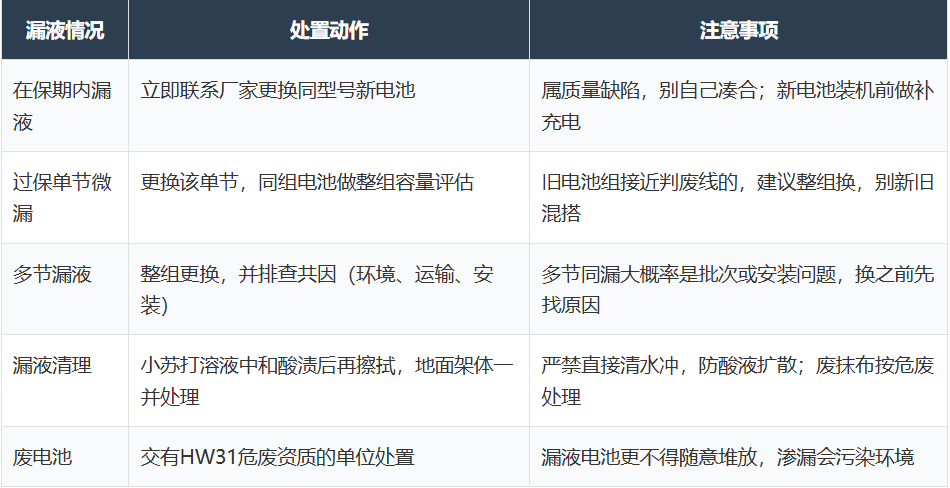
Fourth, if a leak is found, proceed according to this table.
Safety Reminder: Wear acid-resistant rubber gloves and goggles when handling a leaking battery. If acid comes into contact with your skin, wash it immediately with plenty of water. When replacing the battery, wear insulating gloves and use insulating tools. Metal tools are strictly prohibited from covering the positive and negative terminals. Cleaned rags and tissues contaminated with acid should not be discarded voluntarily and should not be included in the hazardous waste disposal program.
Fifthly, it is much more profitable to include inspection defects in the inspection sheet than to correct them later.
The biggest harm of microleaks is “detecting them too late.” Turn this from an accidental discovery into a systemic action: add to the quarterly inspection "body appearance + battery rack", which takes ten minutes to inspect the marker light and rack; combine annual verification discharges, use test strips to confirm suspicious areas and update the weighing archive. Referring to the operation and maintenance requirements of GB 26860-2011 and GB/T 7260.3-2024, checking the appearance of the battery is initially a routine procedure. To be on the safe side, take the time to replace the entire battery pack.
One thing to remember: just because a small leak is not visible to the naked eye, does not mean that there is no leak - shine a light on it from the side, stick test paper on it, wipe it with a white rag and chase away the rust on the shelf. If you take a four-pronged approach, the leak will not be hidden.