
Used lithium battery: purchase and disposal
2026-09-13
- Used lithium battery: purchase, recycling and economic value of recyclable materials
- Technological processes for recycling and recovery of materials
- Economic aspects of purchasing used batteries
- Regulatory and environmental safety
- Benchmark: Recycling vs. Reuse (Second-Life)
- Practical recommendations for preparing batteries for delivery
- The role of integrators in battery life cycle management
- Frequently asked questions (FAQ)
- Conclusion and recommendations for choosing a partner
Used lithium battery: purchase, recycling and economic value of recyclable materials
Power supply lifecycle management is a critical aspect of modern industrial and logistics infrastructure.Waste lithium batteryis not just industrial waste, but a valuable resource containing strategic metals: lithium, cobalt, nickel and copper. In 2026, the efficiency of the processes for purchasing and recycling such batteries directly affects the cost of new energy solutions and compliance with environmental standards. Correct classification, safe transportation and selection of a technological recycling partner allow enterprises to minimize the risks of environmental pollution and return up to 95% of materials to the production cycle.
The handling of failed or end-of-life lithium-ion (Li-ion) and lithium iron phosphate (LFP) batteries requires strict adherence to technical regulations. Unlike traditional lead-acid systems, lithium cells have high energy density and specific chemical reactivity, which dictates special requirements for their storage and dismantling. Energy storage system integration companies such as Nanjing Qiantan Energy Storage Technology Co.,Ltd. emphasize the importance of a closed loop, from battery system design to environmentally friendly recycling. This approach not only ensures compliance with legislation, but also creates a sustainable raw material base for the production of new batteries, including EV traction batteries and stationary energy storage systems.
Classification and types of waste lithium batteries
To organize effective purchasing and subsequent processing, it is necessary to clearly understand the typology of lithium cells. The chemical composition of the cathode determines the method of metal extraction and the economic feasibility of the process. The main categories found in industrial circulation:
- NMC (Nickel Manganese Cobalt):The most common type in electric vehicles and high power tools. Contains high concentrations of cobalt and nickel, which makes it most attractive for hydrometallurgical processing.
- LFP (lithium iron phosphate):Widely used in power backup systems, telecommunications and commercial vehicles. Although LFP batteries do not contain expensive cobalt, they are a significant source of lithium and phosphorus. Their processing requires different chemical reagents compared to NMC.
- LCO (lithium cobalt oxide):Used in consumer electronics. Due to the small volume of individual elements, collection and processing are often carried out centrally through specialized collection points.
- NCA (Nickel Cobalt Aluminum):Used in some models of long-range electric vehicles. Requires careful handling due to high thermal instability in case of mechanical damage.
When evaluating a recyclable lot, the remaining capacity and condition of the case are key factors. Batteries that are recyclable (second-life) are valued differently than those that are subject to complete destruction and extraction of raw materials. Nanjing Qiantan LLC engineers, when auditing projects, take into account the possibility of cascade application: for example, batteries that have exhausted their resource in traction applications can be adapted for stationary energy storage systems of the CP or CL 2V series, if their degradation is within acceptable limits.
Technological processes for recycling and recovery of materials
The modern recycling industry has moved away from simple landfill or low-temperature incineration methods, which were environmentally damaging. Today's standard is complex hydrometallurgical and pyrometallurgical processes that provide a high recovery rate of useful components. The choice of technology depends on the type of battery chemistry and the required purity of the final products.
Pyrometallurgical method
This process involves high temperature treatment (up to 1500°C) in ovens. The organic components of the electrolyte and separators are burned off, serving as a source of energy for the process, and the metal components are reduced to an alloy.
Benefits:Ability to recycle batteries without preliminary deep sorting; high degree of safety against possible short circuits.
Disadvantages:Loss of lithium and aluminum in slag; high energy consumption; the need for additional purification of the resulting alloys. This method is often used as a first step before hydrometallurgy.
Hydrometallurgical method
The most promising direction for 2026. After mechanical grinding and separation of plastic fractions, the active mass is leached with acids or alkalis.
Benefits:High selectivity for the extraction of lithium, cobalt, nickel and manganese (up to 98-99%); the possibility of obtaining high-purity salts suitable for the direct synthesis of new cathode materials; lower energy consumption compared to pyrometallurgy.
Features:Requires careful preparation of raw materials and strict control of chemical reactions to prevent the release of toxic gases.
Mechanical processing and black mass
The first stage of any complex processing is obtaining the so-called “black mass”. This is a powder containing the cathode and anode materials after the casing, foil and plastic have been removed. The quality of the black mass directly affects the efficiency of the subsequent hydrometallurgical stage. It is important that the grinding process is carried out in an inert atmosphere or using special cooling agents to avoid ignition of electrolyte residues.
Economic aspects of purchasing used batteries
Buying marketwaste lithium batteriesis formed under the influence of exchange prices for non-ferrous metals, especially cobalt and lithium. The price per kilogram of battery varies depending on its chemical composition, condition and batch size. For industrial enterprises, the sale of old batteries becomes an income source that offsets the costs of purchasing new systems.
Factors determining the cost of a batch:
- Chemical composition:NMC batteries are rated higher due to their cobalt content. LFP batteries have a lower unit cost of raw materials, but their volume on the market is growing, which stimulates the development of specialized processing lines.
- Remaining capacity:If the battery retains more than 70-80% capacity, it can be sold as a component for second-life systems, which is significantly more expensive than the scrap price.
- Module integrity:Unassembled modules require less preliminary preparation costs, but transporting complete batteries is more dangerous and more expensive due to cargo hazard class requirements.
- Logistics:The distance to the processing plant and the availability of certified ADR class transport affect the final net price for the seller.
Nanjing Qiantan Energy Storage Technologies LLC, having experience in implementing projects in Russia, Iran, Turkey and other countries, integrates reverse logistics services into its contracts. This allows customers not only to purchase new battery solutions (such as OPzV gel batteries or high temperature batteries), but also to intelligently manage the decommissioning of old equipment, maximizing the return on investment.
Regulatory and environmental safety
In 2026, environmental legislation in most countries tightened the requirements for the management of hazard class I and II waste, which includes lithium batteries. Unauthorized storage or transfer of used batteries to unverified intermediaries entails serious fines and reputational risks.
Key requirements for waste generator enterprises:
- Waste certification:Each type of battery must have an appropriate waste passport confirming its chemical composition and hazard class.
- Licensed carriers:Transportation must be carried out by transport equipped in accordance with the requirements for the transportation of dangerous goods, with the availability of emergency cards and fire extinguishing equipment.
- Agreement with the recycler:You must have a valid agreement with an organization licensed to collect, transport and dispose of hazardous waste. Transferring batteries by hand is unacceptable.
- Reporting:Enterprises are required to keep a log of waste generation and movement, submitting reports to supervisory authorities.
Cooperation with companies such as Nanjing Qiantan LLC, which position themselves as full-cycle operators, ensures the legal purity of the transaction. The presence of specialized environmentally friendly recycling workshops and certificates of compliance with international standards guarantees that the transferred batteries will not end up in an illegal landfill, but will be recycled in compliance with all standards.
Benchmark: Recycling vs. Reuse (Second-Life)
When deciding on the fate of used batteries, engineers are faced with a choice between direct disposal and the search for alternative use cases. Below is a comparison of the two approaches.
| Criterion | Direct recycling (Recycling) | Reuse (Second-Life) |
|---|---|---|
| Battery status | Any, including damaged and completely degraded | Residual capacity 60-80%, no physical damage to cells |
| Economic benefit | Depends on exchange prices for metals (Co, Li, Ni). Stable but limited income | High added value. The battery is sold as a functional product |
| Technical requirements | Safe packaging and transport to factory required | Diagnostics, cell rebalancing, BMS and housing replacement are required |
| Application | Extracting raw materials to produce new batteries | Stationary energy storage devices (ESS), uninterruptible power supplies, low-power equipment |
| Implementation period | Fast (transfer to scrap collector) | Long (requires testing and adaptation to new tasks) |
Engineering experience shows that for large industrial facilities a hybrid strategy is most effective. It is advisable to send battery packs that exhibit uneven cell degradation for recycling, since their leveling is not economically justified. At the same time, homogeneous batteries with moderate wear can be successfully integrated into backup power systems, such as the CP series stationary batteries offered by Nanjing Qiantan Co., Ltd. This reduces capital costs for creating spare capacity and reduces the environmental footprint.
Practical recommendations for preparing batteries for delivery
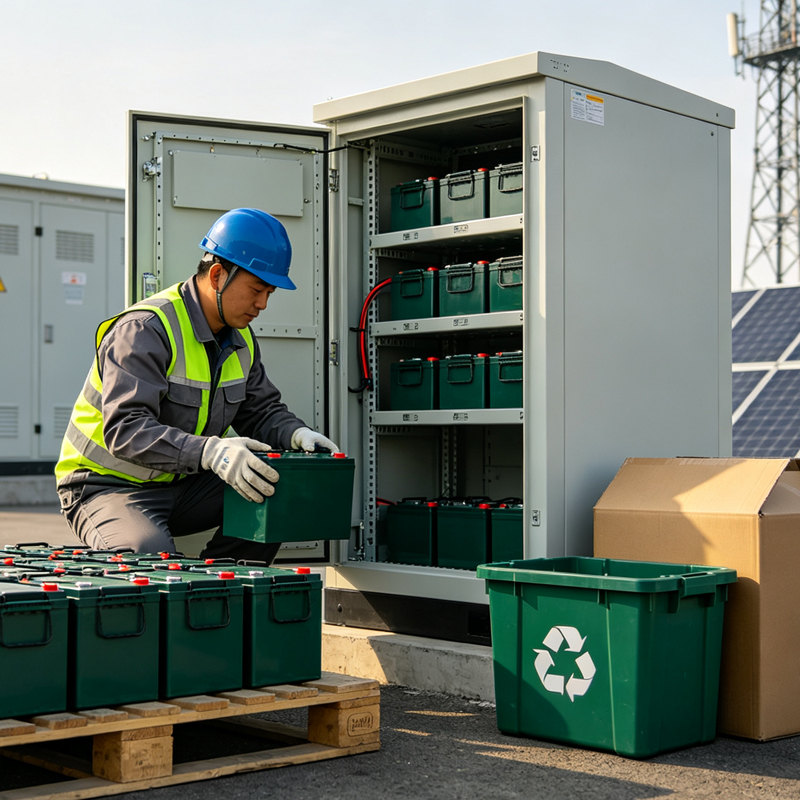
Preparing used lithium batteries for transfer for recycling or purchase requires compliance with strict safety measures. Errors at this stage can lead to thermal runaway, fire and refusal of the receiving party to accept the cargo.
- Terminal insulation:All output contacts must be insulated with non-conductive material (insulating tape, plastic caps) to prevent short circuits.
- Voltage control:It is advisable to discharge batteries to transport voltage level (typically 30-50% SOC) if it is safe to do so and as specified by the manufacturer's instructions. Batteries completely discharged below a critical threshold may become unstable.
- Damage protection:The housings must not have dents, punctures or signs of exposure to moisture. Damaged items must be packed in individual fireproof containers.
- Marking:Each package must be clearly labeled with the chemical type (Li-ion, LFP), weight and Dangerous Goods label.
- Storage:Until removal, batteries should be stored in a dry, cool place, away from flammable materials and heat sources. It is recommended to use metal racks with non-flammable pallets.
The role of integrators in battery life cycle management
The modern market requires an integrated approach. Just buying a new battery is not enough. Leading suppliers such as Nanjing Qiantan Energy Storage Technology Co., Ltd. offer complete lifecycle management services. With a team of 30 years of experience and a global presence, the company not only provides high quality lead acid and lithium solutions, but also advice on their future disposal.
The company's specialists help clients classify waste, select licensed processing partners in a specific region (be it Russia, Vietnam or Türkiye) and optimize logistics. This service is especially important for international companies operating in different jurisdictions with different environmental regulations. Integrating recycling services into the supply contract for new batteries (e.g. EV series traction batteries or 1S series maintenance-free car batteries) creates a transparent and responsible supply chain.
Frequently asked questions (FAQ)
Is it possible to disassemble a lithium battery yourself to return non-ferrous scrap?
Strongly not recommended. Self-disassembly of lithium batteries without special equipment and protection is extremely dangerous due to the risk of short circuits, ignition of the electrolyte and the release of toxic gases. In addition, mixing different fractions reduces their market value. Transfer batteries in their entirety or in the form of modules to specialized organizations.
What is the price per kg of used lithium battery in 2026?
The price varies greatly and depends on exchange quotes for cobalt and lithium, the type of chemistry (NMC is more expensive than LFP) and the batch size. The exact cost can only be determined after examining the sample and analyzing current market demand. Usually the calculation is made individually for each batch.
What to do with a swollen lithium battery?
Swelling indicates gas formation inside the cell due to electrolyte decomposition, which is a precursor to thermal runaway. This battery must not be pressed, pierced or exposed to heat. It must be placed in a separate fireproof container with sand or vermiculite and immediately transferred to a designated hazardous waste collection point.
Do you accept mixed batches of lead and lithium batteries?
Lead-acid and lithium batteries have different processing technologies and hazard classes. Mixing them in one container is prohibited by the rules for the transportation of dangerous goods. However, full-service companies such as Nanjing Qiantan LLC can arrange for separate collection and removal of both types of batteries under one contract, ensuring correct sorting at the loading stage.
How to confirm the fact of recycling for tax and environmental authorities?
After handing over the batteries to the recycler, you must receive a waste acceptance certificate and a recycling certificate (or a recycling certificate). These documents serve as the basis for removing waste from the balance sheet of the enterprise and confirming compliance with environmental requirements. Make sure your partner has a valid license for this type of activity.
Conclusion and recommendations for choosing a partner
Managing waste lithium batteries is a task that requires engineering precision and legal expertise. In conditions of shortage of raw materials and tightening environmental regulations, efficient purchase and disposal become a competitive advantage. Refusal from the spontaneous market of “gray” assemblers in favor of working with official, technologically equipped companies reduces risks and increases economic returns.
When choosing a partner, pay attention to the availability of your own or partner processing facilities, transparency of document flow and the ability to offer comprehensive solutions. Nanjing Qiantan Energy Storage Technology LLC exemplifies this approach by combining the supply of advanced battery systems with life cycle expertise. Collaborating with professionals allows you not only to solve the waste problem, but also to contribute to the formation of a low-carbon economy.
For advice on the supply of new battery solutions and the organization of waste battery recycling channels, check out ourproducts and technical solutions. Our specialists will help you choose the optimal strategy for your enterprise, taking into account the specifics of your region and the types of equipment used.