
Lead-acid battery assembly line: price from the manufacturer
2026-10-01
- Lead-acid battery assembly line: architecture, cost and selection criteria from the manufacturer
- Structure of a modern automated battery production line
- What determines the price of a lead-acid battery assembly line?
- Technology Comparison: Full Automation vs. Hybrid Solutions
- Key technical parameters and equipment requirements
- Real Application Scenarios and Configuration Selection
- The role of the supplier: why the full service cycle is important
- Frequently asked questions (FAQ)
- Conclusion and recommendations for purchasing
Lead-acid battery assembly line: architecture, cost and selection criteria from the manufacturer
Investments inlead acid battery assembly line— this is not just the purchase of conveyor equipment, but the formation of the technological core of the future plant. In 2026, the market requires from manufacturers not only high performance, but also flexible lines for the production of various types of batteries: from starter (SLI) to industrial stationary (OPzV, AGM) and traction solutions. The price of such a line varies widely and directly depends on the level of automation, design capacity (for example, 5,000 or 20,000 batteries per shift) and the integration of quality control systems.
For industrial customers, the key factor is not so much the initial cost of the equipment, but rather the total cost of ownership (TCO), which includes energy efficiency, scrap rate and changeover speed for different models. Nanjing Qiantan Energy Storage Technology LLC, with more than 30 years of experience in engineering expertise, offers an integrated approach to equipping production facilities. We don't just supply machines, we design a complete production cycle, where every piece of equipment - from the grating casting machine to the final voltage tester - works as part of a single ecosystem. This allows our partners in Russia, Turkey and the CIS countries to launch lines that meet strict international safety and environmental standards.
Structure of a modern automated battery production line
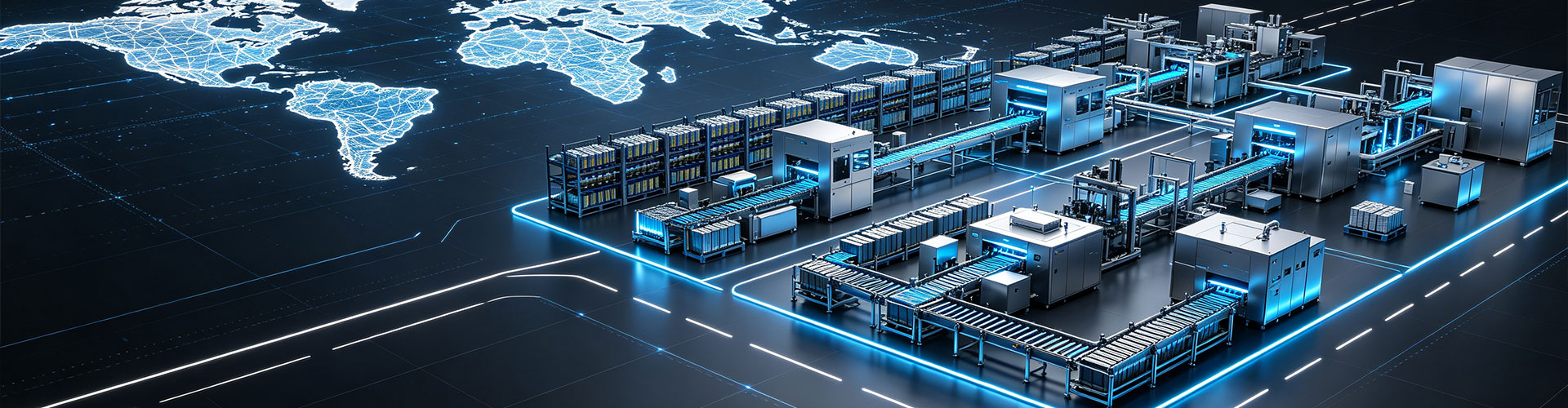
A modern lead-acid battery assembly line is a complex mechatronic complex. An error in choosing one unit can become a bottleneck for the entire plant. The technological process is divided into several critical stages, each of which requires specific equipment.
1. Preparation of plates and assembly of blocks
At this stage, the “heart” of the battery is formed. The equipment must provide high positioning accuracy:
- Stacking machines:Vacuum gripping or mechanical laying technologies are used. For AGM batteries, the accuracy of the separator placement is critical, eliminating micro-short circuits.
- Installation of inter-element connections:Modern lines use the methods of welding through the partition (COS – Cast On Strap) or soldering. COS technology provides lower internal resistance and higher contact reliability compared to traditional soldering, which is especially important for high-power HFS and CT series batteries.
2. Installation in a monoblock and sealing
After assembling the block, the plates are placed in the housing. Two parameters are important here: speed and tightness.
- Heat sealing of the cover:The equipment must control the temperature and pressure at each point of the seam. For maintenance-free batteries of the 1S series and stationary batteries of the CP series, sealing is a guarantee of service life.
- Installation of safety valves:Automated systems for installing VRLA valves prevent drying out of the electrolyte and provide pressure relief in emergency situations.
3. Formation
This is the most energy-intensive and longest stage. Modern plants, implemented by Nanjing Qiantan Energy Storage Technology LLC, are equipped with energy recovery systems that return up to 40-60% of the electricity back to the grid during discharge generation cycles. This significantly reduces operating expenses (OPEX).
What determines the price of a lead-acid battery assembly line?
The request “price of an assembly line” often leads to misunderstandings, since the spread of cost can reach tens of times. To get a quote from a manufacturer that is relevant, you need to understand the pricing structure.
| Influence factor | Impact on cost | Technical justification |
|---|---|---|
| Automation level | High | Fully robotic lines (using KUKA/Fanuc manipulators or analogues) are more expensive than semi-automatic lines, but reduce dependence on the human factor and the cost of payroll. |
| Design capacity | Proportional | A line with 10,000 batteries per shift requires more powerful conveyors, cooling systems and charging modules than a line with 2,000 batteries. |
| Product type | Medium | The production of tubular batteries (CL 2V series) requires specialized equipment for packing the active mass, which makes the line more expensive compared to the production of flat plates. |
| Quality control systems | High | Integration of X-ray weld inspection, automatic voltage and internal resistance testing (Hi-Pot tests) increases capital costs, but radically reduces the risk of complaints. |
| Ecological systems | Medium | Acid mists purification systems and closed water supply cycles are required to comply with Russian and EU regulations. Their presence affects the final estimate of the project. |
It is important to note that low-cost equipment often does not have a modular architecture. When expanding the range (for example, switching from car batteries to OPzV gel batteries), you will have to buy a new line rather than upgrade the existing one. Engineers at Nanjing Qiantan Energy Accumulation Technologies LLC take into account the possibility of scaling when designing, which saves up to 30% of investment in the long term.
Technology Comparison: Full Automation vs. Hybrid Solutions
When choosing a line configuration, the technologist faces a dilemma: maximum automation or a hybrid approach? Let's look at a comparison for a typical plant with a capacity of 5,000 batteries per day.
| Criterion | Fully automatic line | Hybrid (semi-automatic) line |
|---|---|---|
| Capital Expenditure (CAPEX) | Tall. Requires significant investment in software, robots and sensors. | Moderate. The main operations are mechanized, but loading/unloading can be done manually. |
| Personnel requirements | Low. We need 2-3 qualified engineers and operators. | Tall. A large number of workers are required for manual operations. |
| Quality stability | Very tall. Human errors are excluded. | Depends on the qualifications of workers and the motivation system. |
| Changeover flexibility | Average. Requires programming and replacement of tooling. | High. Manual labor is easier to adapt to non-standard formats. |
| Recommended Application | Mass production of standard series (EV, 1S, CP). | Small-scale production, niche products, startups. |
Engineering opinion:For the markets of Russia and the CIS, where there is a shortage of highly qualified line personnel, but there is access to high-quality engineering staff, fully automated lines are more preferable. They provide the stability of parameters required for certification according to GOST and international standards. However, for the launch of pilot projects or the production of specialized EV traction batteries, a hybrid version with subsequent modernization may be appropriate.
Key technical parameters and equipment requirements
When requesting a quote forlead acid battery assembly line, pay attention to the following technical specifications. They determine whether the line can produce products that are competitive in 2026.
- Electrolyte dosing accuracy:The error should not exceed ±1-2 ml. Excess acid leads to corrosion and self-discharge, while too little leads to sulfation and loss of capacity. The equipment of Nanjing Qiantan LLC uses high-precision pumps with mass flow control.
- Welding speed of inter-element connections:For high speeds (more than 1000 cycles per hour) a water cooling system for the welding heads is required. Without it, the quality of the seam degrades after 2-3 hours of work.
- Ventilation and acid resistance system:All contacting parts must be made of PVC, PP or titanium. Ordinary stainless steel quickly corrodes in sulfuric acid vapor.
- Control Interface (HMI):Supports industrial communication protocol (e.g. OPC UA) for integration into the plant MES system. This allows you to monitor the parameters of each specific battery in real time.
Real Application Scenarios and Configuration Selection
The choice of equipment is dictated by the final product. Let's look at two typical cases implemented with the participation of specialists from our company.
Scenario 1: Car Battery Factory (Series 1S)
Conditions:High volumes (10,000+ pieces/day), strict price requirements, standard sizes.
Technical solution:High-speed line with COS (Cast On Strap) technology. The key element is a high-speed bag assembly machine and an automatic forming line with energy recovery. The emphasis is on minimizing cycle time (takt time).
Risks:At high speeds, the risk of welding defects increases. The solution is to install online X-ray monitoring of every second battery or 100% electrical impedance monitoring.
Scenario 2: Production of industrial gel batteries (OPzV, CG Series)
Conditions:Medium volumes, high reliability requirements, long service life (up to 12-15 years), work in telecommunications and energy.
Technical solution:A line with an emphasis on clean processes. Equipment is used to thoroughly rinse the plates after molding to remove any remaining sulfates. Assembly machines operate in a slow, precision mode. Particular attention is paid to the gel electrolyte application system and vacuum sealing.
Engineering advice:For gel batteries, room temperature during assembly is critical. The equipment must be installed in a climate-controlled area (20-25°C) as the viscosity of the gel is highly temperature dependent.
The role of the supplier: why the full service cycle is important
Buying hardware is only 50% of success. The remaining 50% is engineering, installation and training. Nanjing Qiantan Energy Storage Technology LLC positions itself as a full-cycle operator. Our experience of working with such giants as Tianneng and Chaowei, as well as implementing projects in Iran, Vietnam and Pakistan, allows us to avoid typical beginner mistakes.
We provide:
- Adaptation to local conditions:Taking into account climatic features (for example, for regions with hot climates, the cooling system of formation transformers is strengthened).
- Technological support:Our engineers, with over 30 years of experience, help you customize active mass formulations and formation modes for your raw materials.
- Environmental safety:Introduction of closed water supply cycles and acid waste neutralization systems, which is a mandatory requirement for obtaining permits in the Russian Federation and other countries.
Frequently asked questions (FAQ)
What is the estimated cost of a small assembly line?
The cost varies greatly depending on the configuration. A semi-automatic line for a startup can cost from several hundred thousand dollars, while a fully automated plant with a capacity of tens of thousands of pieces per day requires an investment of millions of dollars. The exact price can only be announced after drawing up the technical specifications (TOR) and determining the type of batteries produced (starter, traction or stationary).
Is it possible to upgrade an old line to accommodate new types of batteries?
Yes, but with restrictions. It is usually possible to replace the package assembly and welding areas, as well as update the software of the forming systems. However, if the old line is designed for lead soldering, and you want to switch to COS technology or produce gel batteries, it is often more profitable to build a new line, since the requirements for cleanliness and accuracy of the processes are radically different.
What kind of maintenance is required for an assembly line?
Daily cleaning of acid splashes, weekly calibration of electrolyte dispensers and checking of welding electrodes. Once every six months, a complete diagnosis of mechanical drives and replacement of filters in ventilation systems is required. Nanjing Qiantan LLC provides detailed maintenance regulations and trains customer personnel.
Does equipment affect battery life?
Directly. The quality of welding of intercell connections determines the internal resistance of the battery. Inaccurate electrolyte dosing affects the density balance and service life. Modern automated equipment minimizes these risks, ensuring consistently high quality products.
Conclusion and recommendations for purchasing
Choicelead acid battery assembly lineshould be based on an in-depth analysis of your business model. Do not strive for maximum automation for the sake of prestige if your volumes do not justify these costs. Conversely, do not skimp on quality control systems, as one batch of defective batteries can destroy the brand's reputation in the market.
Practical advice for buyers:Before signing a contract, ask the supplier for a real-time video of the line operation (not a commercial, but a recording from the workshop cameras) and contacts of existing clients in your region. Please note the availability of service support and a spare parts warehouse. Nanjing Qiantan Energy Storage Technologies LLC is ready to provide a detailed audit of your future production, offer the optimal equipment configuration and provide turnkey project support - from the drawing to the first produced battery.
To receive technical advice, calculate the cost of a line for your tasks and get acquainted with our solutions in the fieldproduction of lead-acid batteries, contact our engineers. We will help create efficient and safe production that meets the challenges of 2026.